15 June 2010

Why do we play?

Press to play video

A pioneer in research on play, Dr. Stuart Brown says humor, games, roughhousing, flirtation and fantasy are more than just fun. Plenty of play in childhood makes for happy, smart adults -- and keeping it up can make us smarter at any age.

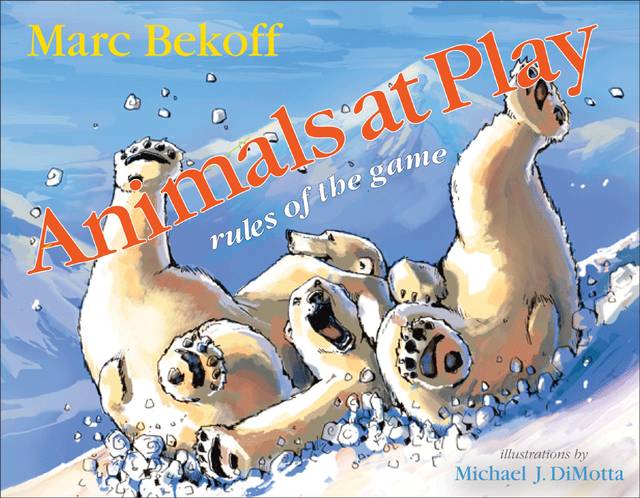
Animals at Play: ethology for kids shows that play is universal


Marc Bekoff's Animals at Play: Rules of the Game is a kids' picture book about ethology -- animal behavior -- and play. Informative and fun, the book looks at how many species of mammals and fish play together, among children, adults, and in mixed groups or pairs. Bekoff, an ethologist who taught biology at the University of Colorado and co-founded Ethologists for the Ethical Treatment of Animals is very comfortable communicating ideas to young people in simple terms that nevertheless convey accurate scientific principles.
I loved this book. The subject -- play -- is one that every kid and parent is immersed in, but perhaps without much conscious thought. By using delightful examples from the animal kingdom, Bekoff invites the reader to investigate the unwritten rules of human play, as with coyotes' insistence on fairness in play, or the way that adult wallabies will "self-handicap" when tussling with adolescents. By linking fun, sociality, apology, fairness, and communication, Bekoff conveys just how fundamental play is to our own lives. What an excellent thing to be reminded of.
Animals at Play: Rules of the Game

Games Animals Play


 To write about the natural history of games and play, I decided to consult an expert. The other day, as I was twirling my 5-year-old daughter around so that she could pretend she could fly with her fairy wings, I asked her why she likes to play.

Charlotte flew on in silence for a moment. I could tell my question seemed strange to her. "Everyone likes to play," she said. "Except for grown-ups."
I suppose the thought of not playing is just too absurd for a 5-year-old to take seriously. Play is a kind of lingua franca for children. Charlotte gets a bit shy when we visit friends, but if there's a child in the house who's ready to share a train set or a princess costume, she takes off in a sprint. I might as well have asked her why she eats or sleeps.

It's hard enough for a child to explain why she likes to play. So imagine trying to get a straight answer from an octopus. For centuries, naturalists have observed animals doing something that looks an awful lot like playing. Horses kick and dance. Dogs wrestle each other to the ground. Warblers toss rocks. And when scientists give octopuses Lego blocks, they seem to have a lot of fun batting them around with their tentacles. But it is a supreme challenge to determine if they are actually playing in the same way Charlotte does, or if we are just projecting our own experiences on an alien animal kingdom. In fact, many scientists who study animal behavior avoid the question of animal play, because it is just so hard to tell if they're having fun.

In his recent book, The Genesis of Animal Play, psychologist Gordon Burghardt argues that play is a distinctive distortion of other kinds of behavior. Play is not a means to an end, but an end in itself. Charlotte loves to wrestle with her younger sister Veronica, for example, but thankfully, she doesn't beat her senseless. Play occurs spontaneously, Burghardt argues, and it is rare in times of stress. And, last but not least, play is fun.

07 December 2009

What enables us to innovate, problem-solve, and be happy, resilient human beings?

Our ability to PLAY!

We've all seen the happiness in children's faces while they play in the school park. Or the blissful abandon of a golden retriever racing with glee across an open lawn. This is the joy of play. By definition it is purposeless, all-consuming and restorative. Play is its own reward and most important, it's fun.
 

21 October 2009


How our brains work when it tries to understand other people's thought processes.


A super cool video about how our brains work when it tries to understand other people's thought processes. Rebecca Saxe from MIT reveals a pretty amazing discovery, which is that all people have a tiny region in their brains that's responsible solely for judging other people's thoughts.


Rebecca illustrates the growth of this region of the brain by studying it's changes in children. From 3 years-old and onwards, we can see how this area of the brain develops and how their thought processes change.

06 October 2009

Thoughts to ponder....


In dwelling, live close to the ground.
In thinking, keep to the simple.
In conflict, be fair and generous.
In governing, don't try to control.
In work, do what you enjoy.
In family life, be completely present.

29 September 2009

2 Happy Rules That Drastically Changed My Life – A Guide To Leading Your Kids Towards Happiness

Is happiness a stroke of luck?


Have you ever asked yourself, what is the meaning of happiness?  How does one become happy?  Do we have to be blessed to have a happy life, to have great kids and be surrounded by love and laughter?
It sometimes may seem that way.  We look around and see a family or a person that seems to have the perfect life.  Some people may think this exact thing when they look at me and my girls.  Who can blame them? Just look at our typical weekend; we are in Borneo in one and Bali the next. We're always laughing and goofing around... we're always happy.
But little do they know that my life was very different three short years ago.